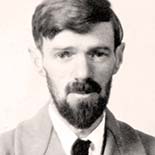
 David Herbert Lawrence (September 11, 1885 – March 2, 1930) was an English writer, novelist, poet and essayist. His works reflect on modernity, industrialization, sexuality, emotional health, vitality, spontaneity and instinct. His best-known novels—Sons and Lovers, The Rainbow, Women in Love, and Lady Chatterley’s Lover— were the subject of censorship trials.
Lawrence’s opinions and artistic preferences earned him many enemies, and he endured persecution and misrepresentation of his creative work throughout the second half of his life, much of which he spent in a voluntary exile, four years of which he described as a “savage enough pilgrimage”. At the time of his death, his public reputation was that of a pornographer who had wasted his considerable talents. However, English novelist and critic E. M. Forster, in an obituary notice, challenged this widely held view, describing him as “the greatest imaginative novelist of our generation.” Later, English literary critic F. R. Leavis also championed both his artistic integrity and his moral seriousness.
THE BODY OF GOD
D. H. Lawrence
God is the great urge that has not yet found a body
but urges towards incarnation with the great creative urge.
And becomes at last a clove carnation: Io! that is god!
and becomes at last Helen, or Ninon: any lovely and generous woman
at her best and her most beautiful, being god, made manifest,
any clear and fearless man being god, very god.
There is no god
apart from poppies and the flying fish,
men singing songs, and women brushing their hair in the sun.
The lovely things are god that has come to pass, like Jesus came.
The rest, the undiscoverable, is the demiurge.
=====
LEDA
D. H. Lawrence
Far-off
at the core of space
at the quick
of time
beats
and goes still
the great swan upon the waters of all endings
the swan within vast chaos, within the electron.
For us
no longer he swims calmly
nor clacks across the forces furrowing a great gay trail
of happy energy,
nor is he nesting passive upon the atoms,
nor flying north desolative icewards
to the sleep of ice,
nor feeding in the marshes,
nor honking horn-like into the twilight.
But he stoops, now
in the dark
upon us;
he is treading our women
and we men are put out
as the vast white bird
furrows our featherless women
with unknown shocks
and stamps his black marsh-feet on their white and marshy flesh.
=====
MYSTIC
D.H. Lawrence
They call all experience of the senses mystic, when the experience is considered.
So an apple becomes mystic when I taste in it
the summer and the snows, the wild welter of earth
and the insistence of the sun.
All of which things I can surely taste in a good apple.
Though some apples taste preponderantly of water, wet and sour
and some of too much sun, brackish sweet
like lagoon-water, that has been too much sunned.
If I say I taste these things in an apple, I am called mystic, which means a liar.
The only way to eat an apple is to hog it down like a pig
and taste nothing
that is real.
But if I eat an apple, I like to eat it with all my senses awake.
Hogging it down like a pig I call the feeding of corpses.
======
ONLY MAN
D. H. Lawrence
Only man can fall from God
Only man.
No animal, no beast nor creeping thing
no cobra nor hyaena nor scorpion nor hideous white ant
can slip entirely through the fingers of the hands of god
into the abyss of self-knowledge,
knowledge of the self-apart-from-god.
For the knowledge of the self-apart-from-God
is an abyss down which the soul can slip
writhing and twisting in all the revolutions
of the unfinished plunge
of self-awareness, now apart from God, falling
fathomless, fathomless, self-consciousness wriggling
writhing deeper and deeper in all the minutiae of self-knowledge,
downards, exhaustive,
yet never, never coming to the bottom, for there is no bottom;
zigzagging down like the fizzle from a finished rocket
the frizzling falling fire that cannot go out, dropping wearily,
neither can it reach the depth
for the depth is bottomless,
so it wriggles its way even further down, further down
at last in sheer horror of not being able to leave off
knowing itself, knowing itself apart from God, falling.
======
SONG OF DEATH
D.H. Lawrence
Sing the song of death, O sing it!
for without the song of death, the song of life
becomes pointless and silly.
Sing then the song of death, and the longest journey,
and what the soul takes with him, and what he leaves behind,
and how he enters fold after fold of deepening darkness
for the cosmos even in death is like a dark whorled shell
whose whorls fold round to the core of soundless silence and pivotal oblivion
where the soul comes at last, and has utter peace.
Sing then the core of dark and absolute
oblivion where the soul at last is lost
in utter peace.
Sing the song of death, O sing it!
=====
D.H. Lawrence