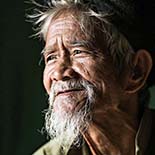
 Yang Wan-Li, Chinese poet, born 1127. He attained the jinshi degree in 1154 and rose to the position of Academician of the Baomo Pavilion. Breaking free from the constraints of the Jiangxi School of Poetry, he pioneered the lively and natural “Chengzhai Style,” advocating for learning from nature and employing plain yet profound language. His poetry, often drawing inspiration from everyday life, profoundly influenced later schools of lyrical expression, particularly the Xingling (Spirit and Sensibility) School.
Yang Wan-Li
If you say it is simply a matter of words,
I will say a good poet gets rid of words.
If you say it is simply a matter of meaning,
I will say a good poet gets rid of meaning.
“But,” you ask, “without words and without meaning,
where is the poetry?”
To this I reply: “Get rid of words and get rid of meaning,
And there is still poetry.”
MOUNTAIN SHRINE TOWER IN AUTUMN
Yang Wan-Li
Between shores, mountains welcome me,
and in these river shallows, willows bow.
Sunlight jostles water cascading through
dragon’s whitewater scales. Why not stay?
I’ll ask this shrine-tower the way through
our surging and swelling world, and gaze
my whole life at this fluid mirror,
seeing thousands of ages lighting a Buddha face.
======
Yang Wan-Li
now you read books on fortunetelling
and look at scholars with cold eyes,
Master Tseng, will you be my friend?
Together we’ll get into a fishing boat
and sail off to the Five Lakes.
WHERE COULD
Yang Wan-Li
Where could those waters
stretching toward me begin,
and how did these thousand
peaks come to settle there?
It’s the most marvelous shrine–
room: ten million wide–
open miles of misty wave, and
one soaring gull, white.