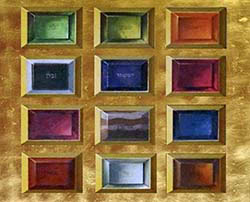
 Mel Alexenberg is Professor and Chairman of Fine Arts at Pratt Institute.
Rabbi Alter Ben-Zion Metzger is a Chassidic scholar and Professor of Judaic Studies at Stern College for Women.. Yaacov Ort, editor at the New York Times, was mediator at this dialogue.
M. Alexenberg:
When we discuss aesthetics in Judaism, it is very important that we understand that the very meaning of art in Jewish life is not only different from the concept in Western culture, but I think it is exactly the opposite.
Just take the words themselves. The word oman, “artist” in Hebrew is the same as amen, which means emet, “truth.” Its feminine form is emunah, “faith,” and as a verb, it’s “to educate, to nurture” – amen. So Jewish artistry is about truth, faith and education.
But the English word “art” is the root of “artificial” and “artifact.” “Kunst” – the German word for “art” means “phony” – it’s about copy, imitation, and counterfeit. They are not only different, “oman” and “art,” they are completely opposite. Western art is based on the Hellenistic view that nature is the height of creation and that man’s job is mimesis, imitating nature.
In Judaism, however, nature is incomplete, and man is the partner of G-d in the continuing creation. There is a story in the Midrash about a Roman official who asks Rabbi Akiva, “Which is greater or more beautiful, man’s creations or G-d’s?” When Rabbi Akiva says that man’s is greater, the Roman is shocked, “How can you say that?” he asks, “look at the sun, the sky, the stars and all!” Rabbi Akiva then brings a plate of wheat grains for the Roman and he takes a plate of cake for himself. The puzzled Roman asks, “How come I get wheat and you get cake?” And Rabbi Akiva replies, “Well, you prefer G-d’s creation, I prefer man’s.”
There is a continuing process to creation and I think that the job of the artist in Judaism is not to imitate the creation – that leads to idolatry, which is making the dynamic world static and then worshiping it – but rather to create new worlds. It is about making cake out of wheat. It is not to imitate the creation, but to imitate the Creator in the process of making the world.
The thrust of art in the 20th century is towards the abstract. There is an aesthetic awareness of something higher than reality. We might say that aesthetics is a threshold for the consciousness of the transcendental.
Indeed, G-d manifests himself through the sefirah (at-tribute) of Tiferet – beauty. What is the meaning of Tiferet? It is the combination of the elemental attributes of Chesed (kindness) and Gevurah (restraint) which creates harmony and contrast. Thus the artist can become a prism for the revelation of Divine Tiferet.
Y. Ort:
Can you have great art, worthwhile art, which is created by an evil person?
A.B. Metzger:
We have a concept in mysticism and in Chassidus of Zeh-Leumat-Zeh, ”This corresponds to that.” Everything that exists in the realm of virtue exists in the realm of evil. And obviously, in asking this question, you yourself are very conscious of the fact that Germany reached the highest levels of creativity. So obviously you can have art forms created by both, the virtuous individual and the evil individuals.
Art is expressive of inner qualities of man that we sometimes can’t capture. Art can manifest itself in two ways –by constructive, affirmative matter or the opposite, evil manifestation.
There’s a story told about the Baal Shem Tov: There were once people carving idolatrous form out of ice and the Baal Shem Tov stood there and gazed at this. His students knew how much he avoided looking at anything that was evil by nature, and they asked him why he did this. He replied that water purifies all forms of impurity but if it becomes frozen, it becomes something that can be used for evil purposes, for purposes of idolatry.
Abraham, the first Jew, also saw the duality of art. On the one hand, Abraham had a deep sensitivity to art through nature. Through his aesthetic-intellectual perception of the order and harmony of nature, Abraham came to an understanding of the unity or oneness of G-d. On the other hand, his father owned a shop of idolatrous figures which Abraham smashed because of the repugnance of the meaning of idolatry. So that one aspect of Abraham’s aesthetic sense could bring him closer to G-d, but he also had this awareness that there had to be a rejection of any art form that could alienate man from G-d.
The burning bush through which G-d revealed himself to Moses is a good analogy for the artist. The Torah says that the bush was burning and yet it was not destroyed, it was not consumed. In certain instances we have artists who place incredible emphasis upon the artistic experience and the intensity of the emotion is the ultimate end. This is particularly true of our own time where there are so many different kinds of creative people. We see a lot of distressing things that are happening within the creative community. And I think that the creative person has to have illumination, yet he cannot permit himself to be consumed by his passion for the aesthetic. He must consistently recognize that the aesthetic is a means to a higher goal.
There are two scenes of martyrdom that are related to our discussion; The martyrdom of Rabbi Akiva and that of Socrates. When Rabbi Akiva was being tortured to death he told his students that his entire life he longed to sacrifice his life for G-d – he waited for the affirmation of his faith in G-d. On the other hand, Socrates, who had a lifelong quest for knowledge, was at the moment of his death, completely obsessed with the effect of the hemlock on himself. This is very much like what has happened in the twentieth century where knowledge has become an end in itself. We have military laboratories with incredible, sophisticated creative people, and creativity and knowledge are regarded as an end in itself, no matter what it leads to. But what they are creating is a universal hemlock. We have to realize that knowledge and aesthetics are not ends in themselves and are not merely for human gratification.
M. Alexenberg:
In Genesis, where the Torah talks about the Tower of Babel, we learn about the creative process that leads to destruction. The problem with the Tower of Babel was its convergence. The people were sup-posed to be speaking all different languages and be spreading out around the world. Instead, they came and built this singular tower, this single-point kind of motion, which is like the single-point perspective of Renaissance art, which is idolatry and destruction. I recently saw a poster in a bank, it said, ” Xmas Club-Chanukah Club,” and it had two symbols there. It had the Xmas tree, which converges at a single point just like the single-point perspective of Renaissance painting, and then it had the Menorah which is a tree form also – but it’s a tree that branches out in multiple paths, not this kind of convergence. It’s like the tallit stripes, which are parallel stripes. If you take the stripes of Christianity, it’s the two stripes that converge on a single point.
In Noach, I found the meaning of beauty. The Jewish concept of beauty is Chen, grace. Chen is an inner beauty. The letters of Chen and Noach are the same. And the relationship of the sons is like the relationship of the sense modalities in creating the Chen. It says in Genesis: “G-d shall enlarge Yefet, and he shall dwell in the tents of Shem, and Kenaan shall be his servant.” So Yefet will become great and large. To play on the word for Western beauty, Yafah, is the surface beauty. It will dwell within the tents of Shem, and it will be served by the sons of Cham. Yefet is the visual, Shem is shmiah, audial and Cham is the tactile. So there is a formula here in Torah on how they relate to each other. It says, you take the visual and put it inside, you wrap it with the audial, and serve them both with the tactile, so the tactile senses serve both the visual and audial. And this together is Chen – beauty, the integration of the senses and not the separation.
The Western world separated the senses. You go to a museum, and there are guards to see that you experience the valued object just visually. You’re not allowed to touch. Take the most valued object in Judaism, the Torah scroll and think about how we relate to it. We dance with it and we hug it, kiss it, pass it from hand to hand. Could you imagine if I took the Rembrandt off the wall in the Metropolitan Museum of Art and kissed it and started dancing down the street with it? I’d be dragged off to a police station or an insane asylum. In other words, Judaism relates to the valued object with all the senses. You see it, you hold it up, and open it, you point your finger, read it and tum it into the audial, you interact with it with all your senses.
In Western life, the visual is separated from all other senses. I think that all the alienation of Western culture comes from this. Because the visual sense divorced from the others is the only sense that of its very biological nature drives you out of the world. I can put my ear on my child’s chest and hear his heartbeat; I can put a flower on my nose and smell it; I can put food in my mouth and taste it and I can put my fingers on something and feel it. But if I put some-thing to my eyes, I can’t see it. I have to move it away from my eyes in order to see it. And it is the only one of the senses that has an anatomical mechanism to close it off, I have eyelids. But when it is separated from the other senses, when it doesn’t become this inner kind of vision, it is a sense that can take you away from the world and close off the world. The visual in Western life lacks this holistic multi-sense experience, and that is a very alienating experience.
A.B. Metzger:
The visual experience penetrates far more deeply into the soul of the perceiver and consequently causes far more awareness than the aural experience.
The Torah says that at Mt. Sinai, the people “saw the sounds.” The commentary explains that they saw that which is to be heard – that which is to be comprehended, and they comprehended that which is to be seen. In other words, their whole perception of reality was inverted. So at Mt. Sinai, the immediate, vibrant, meaningful reality was the seeing of the spiritual, and they were only conscious of the physical.
There is a story told of a king who granted his people access to the many treasures of his palace. In each one of his rooms he had precious treasures. The king himself was in the innermost room of his palace. Most of the men were so taken by the beauty of the art and the treasures, they never quite made it to the king’s chamber. Only the wise men surged past the rooms of art to the innermost chamber where the king could be found. What we’re saying here is that these external rooms can be compared to a ladder, and there should be a progressive kind of elevation, a progressive kind of ascent which draws man to a recognition of G-dliness making him capable of ultimately entering into the innermost room of the encounter with transcendence itself where the aural and the visual in the normal sense can’t take place.
Y. Ort:
I was fascinated by an exhibit at the Tzivos Hashem’s Children’s Fair where they demonstrated how 2000 years ago Jews actually performed 39 categories of labor that are prohibited on Shabbos. The exhibit took you from one step to another in the baking of bread, in the making of wool, etc. There were representations of people making something out ofG-d given natural objects, and creating something, making things in a very homemade way. In a sense they were expressing their own art working with G-d’s natural elements.
But since the beginning of the Industrial Revolution and even more so today, the objects that we are surrounded by are not natural objects. They are man-made objects. Basically, we don’t find ourselves working with the objects of nature in a way that we can actualize much the beauty of Torah on a day-to-day basic. So, how do we, living in 1989, in a basically artificial world, express ourselves through nature to create artistic objects?
M. Alexenberg:
You just mentioned the 39. different melachot, kinds of labor. That is art. In fact, the definition of art is that which you don’t do on Shabbos. If you wanted to find out what artistic activity is, whatmelacha is, you should know the difference between melacha (a craft) and malach, (an angel, or messenger). Themalach is the Divine inspiration, the cosmic message from the upper sefirot. That’s masculine, and it is received by the physical world. And then you make melacha, which is feminine, which creates new angels, new cosmic messengers. And I think it’s related. It’s a central idea that I play with a lot in my own art. It’s actually from an article that the Lubavitcher Rebbe sent me a few years ago, about the connection between ruach and chomer, the spiritual and the material. An artist deals with that connection. An artist works with physical materials and with spiritual messages. The words chomer and ruach are basi-cally the same word backwards (the Hebrew letters vov and mem are interchangeable). What’s the difference between the physical and the spiritual world? It is the angle of vision. If you look at it one way, it’s just a physical world. If you shift your angle of vision, suddenly it becomes spiritual. And I think Judaism is about the transformation. It’s not as in other religions, Western and Eastern, where to become spiritual you need to escape the material. Judaism is the transformation of material. You say a blessing on food, it’s about very physical matter.
There was a conference that the Israeli Ministry of Education organized, and they invited artists and rabbis. We were discussing this idea and Rabbi Adin Steinsaltz said to me, “Do you realize that the ultimate materialism that is looked down on by the Western intellectuals is wine, women and song? And yet,” Rabbi Steinsaltz went on to say, “you say Kiddush on wine, Kiddushin on women, and Song of Songs is Kodesh Kodashim. ” The holiest of holy in Jewish life is wine, women and song!
The very thing that Western culture says is the most crass materialism, the Jew takes and transforms to the highest holiness. It’s this very transformation of the material into the spiritual, I think, that is the very essence of Judaism, and certainly is what the Jewish artists should be doing.
A.B. Metzger:
We find that the concept of the sanctification of the corporeal is very important . We find many a Torah teaching that emphasizes the requirement to elevate the material-physical world. The Lubavitcher Rebbe once said that all the technological advances that we see in our own times are basically derivative in terms of the miracles of the past. Now obviously this is a profound statement with all kinds of implications. So somebody interested in dealing with raw materials, all credit to them. But the Baal Shem Tov and Chassidus in general, emphasize that from everything we see in the world, we can serve G-d, including technology. Indeed, from clay we can make pottery, we can have Grandma Moses kind of art. On the other hand, technology also can serve G-d, it can also be elevated, and this technology can also be used in terms of revealing G-dliness within the world.
Understanding complex scientific knowledge makes us more aware of the incredible profundity of existence. Chassidus speaks about the fact that G-d as a Creator did not merely create the world and permit it to exist as a great alarm clock, as an independent entity. Rather, the Ten Utterances of Creation really, conceptually, mean that there is an extension of spirituality within them. And these are the inner animating, vivifying forces of the world. Therefore, when we use all of these means of technology, if we have the Fax machine or other kinds of instruments that can find new dimensions of life, they too can be spiritual channels. Basically what we have before us is an unfolding universe in terms of its beauty.
G-d is an incredible artist – each little flake of snow has its unique shape. We find man, too, is individuated. Therefore, what man has to do is to realize that these entities are not merely independent unto themselves. But there is a danger here. Certain artistic individuals can feel that they’re related to a higher ideal, but all of us know the danger of narcissism in art. The narcissism can be that in creating objects of beauty, that there’s some kind of a self-exalting grandiosity — man feels that he controls environment.
Reb Shamshon Refael Hirsch speaks about the unique-ness of Shabbos and says that the six days of the week, man controls his environment, he is the master of the universe. What does the artist do? The artist too, becomes the master. But on Shabbos, an invisible hand comes, self-imposed, and enclosing constraints are imposed on us. What we really declare, what we’re really affirming by not working on Shabbos is that we really don’t control our environment, that there’s an ultimate control, and that G-d has given us the mandate to work the rest of the week.
The Baal Shem Tov said that from everything we see in the world we can learn to serve G-d. Man’s ceativity is rooted in the fact that man is born B’tzelem Elokim, in a G-d-like image. So G-d is unfolding, revealing new horizons, and we have to use these new horizons for the elevated, the heightened consciousness of the Master of Creation. What we see here is that man, with a G-d given quality, is revealing that which was inherent in all existence prior to this moment.
At every moment G-d gives us a new key. It isn’t that we can object and say we were dealing with elemental things in the past and now we’re dealing with artificial things. These, too, are things that G-d gave, created, and let them remain there for a certain time to be revealed and we have to use them in a creative way.
M Alexenberg:
I think that we’re at the beginning of the Elec-tronic Age now, and I think that the electronic revolution is qualitatively the greatest revolution in the his-tory of humanity. There were two other great revolutions. But in fact, they weren’t big changes. They were quantitative changes. In the Agricultural Revolution, they started using an ox instead of their arms to plow so that the revolution was an extension of muscle – the muscular system. In the Indust-rial Revolution, instead of an ox, you used a tractor, and instead of a horse you used an automobile. But this too was merely an extension of the muscular system.
The Electronic Age, however is an extension of the central nervous system. It’s about processing and manipulat-ing information. And so we have a computer that gives us another brain, that can process and store information in ways that we could never do. It gives us another brain in addition to ours. And then our whole nervous system spreads out with telecommunications systems. I can speak to anybody in the world. When I call my kids in Israel, I speak into tomorrow. So that time and space are radically changed.
There’s a connection between the deep structure of Jewish consciousness and the thought patterns demanded in the electronics revolution. Don’t forget, the end product of the Industrial Revolution was Auschwitz. The Jew never found his place in the Europe of the Industrial Revolution. The machine world wasn’t the world that he could function in and succeed in. But he is very successful in the electronic world, because of the connection between the electronic world and the deeply Jewish world view.
In the electronic world, you store information in spirals. Like the audiotape, a floppy disk for a computer, a videocas-sette, a phonograph record, or CD, or whatever electronic information you store, it’s in a spiral. And the information is transmitted in branching systems – telephone lines and the like. Those are the two symbols of Judaism, the spiral and the branches. The tzitzit have the spiral, a knot and then a spiral which branches out. The Menorah, which is the continual symbol of Judaism is this branching system. The Jews are called Am HaSefer, translated as “people of the book.” Truthfully, however, Sefer means spiral. It doesn’t mean book. We are not people of the book. We are the people of the spiral. We don’t fulfill our religious obligations when we read the Torah in synagogue from a book even though the words are the same as they are in the Torah scroll. Because the medium is an integral part of the message. If you put the Torah between two covers – if you put it in a rectangle, you make it finite. A Torah scroll is like a Moebius strip – an endless flow. The form has to be Ein Sof – endless, because that is the message, not only the medium.
The industrial world set everything up in rectangles – information, architecture, time, the calendar – everything is in rectangles. In Judaism, we find that the rectanglemalben is brickyard. The rectangle enslaves us. So if we have a rectangular garment, what are we supposed to do with it? We have to rip open the comers with tzitziot, let the energy flow out and reach out from the corners. If you have a house, how do you make it Jewish? You mark the break in the wall – the door, the gate, with a mezuza scroll.
Egyptian art, on the other hand, had the big, golden circle. That was the sun god. In Hebrew, golden circle and golden calf are the same. And that is idol worship. It is closed, like the rectangle. The spiral is an open-ended form. It can continually grow. In a branching system you can always add another branch because they are not closed-ended systems. As a matter of fact, all life systems are encoded that way. The DNA molecule, the double helix, keeps all the information of all living forms – encoded in this double helix, just like we encode the Torah in the double spirals. We write it in the same structure as all of life systems. As an artist, I need to deal with forms – with rectangles, with circles – which I know are slavery and idolatry, and those are the common forms – the West is a rectangle, and the forms of the East are the circle. But in Judaism, you have the open-ended spiral growing systems.
— © Wellsprings. Nissan/Iyar, 1989