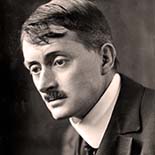
 John Edward Masefield, (June 1878 – 12 May 1967) was an English poet and writer. He was Poet Laureate from 1930 until his death in 1967, Among his best known works are the children’s novels The Midnight Folk and The Box of Delights, and the poems “The Everlasting Mercy” and “Sea-Fever”. Shortly after his death his house burned down and was later replaced by a Cheshire Home named after him. In 1921 Masefield gave the British Academy’s Shakespeare Lecture and received an honorary doctorate of literature from the University of Oxford. In 1923 he organised Oxford Recitations, an annual contest whose purpose was “to discover good speakers of verse and to encourage ‘the beautiful speaking of poetry'”.
THE BUILDERS
John Masefield
John Masefield
Before the unseen cock had called the time,
Those workers left their beds and stumbled out
Into the street, where dust lay white as lime
Under the last star that keeps bats about.
Then blinking still from bed, they trod the street,
The doors closed up and down ; the traveller heard
Doors opened, closed, then silence, then men’s feet
Moving to toil, the men too drowsed for word.
The bean-field was a greyness as they passed,
The darkness of the hedge was starred with flowers,
The moth, with wings like dead leaves, sucked his last,
The triumphing cock cried out with all his powers ;
His fire of crying made the twilight quick,
Then clink, clink, clink, men’s trowels tapped the brick.
I saw the delicate man who built the tower
Look from the turret at the ground below,
The granite column wavered like a flower,
But stood in air whatever winds might blow.
Its roots were in the rock, its head stood proud,
No earthly forest reared a head so high ;
Sometimes the eagle came there, sometimes cloud,
It was man’s ultimate footstep to the sky.
And in that peak the builder kept his treasure,
Books with the symbols of his art, the signs
Of knowledge in excitement, skill in pleasure,
The edge that cut, the rule that kept the lines.
He who had seen his tower beneath the grass,
Rock in the earth, now smiled, because it was.
How many thousand men had done his will,
Men who had hands, or arms, or strength to spend,
Or cunning with machines, or art, or skill !
All had obeyed him, working to this end.
Hundreds in distant lands had given their share
Of power, to deck it ; on its every stone
Their oddity of pleasure was laid bare,
Yet was the tower his offspring, his alone.
His inner eye had seen, his will had made it,
All the opposing army of men’s minds
Had bowed, had turned, had striven as he bade it,
Each to his purpose in their myriad kinds.
Now it was done, and in the peak he stood
Seeing his work, and smiled to find it good.
It had been stone, earth’s body, hidden deep,
Lightless and shapeless, where it cooled and hardened.
Now it was as the banner on man’s keep
Or as the Apple in Eden where God gardened.
Lilies of stone ran round it, and like fires
The tongues of crockets shot from it and paused,
Horsemen who raced were carven on’t, the spires
Were bright with gold ; all this the builder caused.
And standing there, it seemed that all the hive
Of human skill which now it had become,
Was stone no more, nor building, but alive,
Trying to speak, this tower that was dumb,
Trying to speak, nay, speaking, soul to soul
With powers who are, to raven or control.
====
THE RACER
John Masefield
John Masefield
I saw the racer coming to the jump,
Staring with fiery eyeballs as he rusht,
I heard the blood within his body thump,
I saw him launch, I heard the toppings crusht.
And as he landed I beheld his soul
Kindle, because, in front, he saw the Straight
With all its thousands roaring at the goal,
He laughed, he took the moment for his mate.
Would that the passionate moods on which we ride
Might kindle thus to oneness with the will;
Would we might see the end to which we stride,
And feel, not strain in struggle, only thrill,
And laugh like him and know in all our nerves
Beauty, the spirit, scattering dust and turves.
====
SEA-FEVER
John Masefield
I must go down to the seas again, to the lonely sea and the sky,
And all I ask is a tall ship and a star to steer her by;
And the wheel’s kick and the wind’s song and the white sail’s shaking,
And a grey mist on the sea’s face, and a grey dawn breaking.
I must go down to the seas again, for the call of the running tide
Is a wild call and a clear call that may not be denied;
And all I ask is a windy day with the white clouds flying,
And the flung spray and the blown spume, and the sea-gulls crying.
I must go down to the seas again, to the vagrant gypsy life,
To the gull’s way and the whale’s way where the wind’s like a whetted knife;
And all I ask is a merry yarn from a laughing fellow-rover,
And quiet sleep and a sweet dream when the long trick’s over.