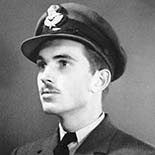
 John Gillespie Magee Jr. (June 9, 1922 – December 11, 1941) was a World War II Anglo-American Royal Canadian Air Force fighter pilot and war poet. He was killed in an accidental mid-air collision over England in 1941.
Magee’s posthumous fame rests mainly on his sonnet High Flight, which he began writing on August 18, 1941 (a few months before his death) while stationed at No. 53 OTU at RAF Llandow in Wales. The poem was inspired by high-altitude training sessions with his squadron. Magee enclosed the poem in a letter to his parents, dated September 3, 1941. His father, then curate of Saint John’s Episcopal Church in Washington, D.C., reprinted it in church publications. The poem became more widely known through the efforts of Archibald MacLeish, then Librarian of Congress, who included it in an exhibition of poems called “Faith and Freedom” at the Library of Congress in February 1942. The manuscript copy of the poem remains at the Library of Congress.
HIGH FLIGHT
John Gillespie Magee Jr.